 InternationalSat, Sep 26 3:30 PM CDT
Home
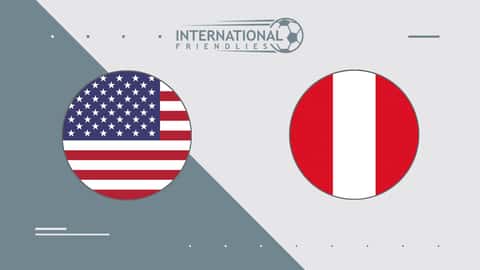
USA
VS

Away
Peru
Lines not posted yet
Sportsbooks usually open this market closer to game time. The comparison appears here the moment they do.



Get odds & game alerts
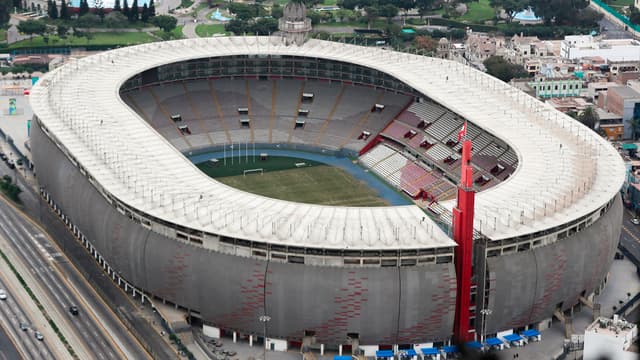
The National Stadium of Peru (Spanish: Estadio Nacional del Perú, pronounced ) is a multi-purpose stadium in Lima, Peru. Its current capacity is 40,272 seats as stated by the Peruvian Football Federation and Instituto Peruano del Deporte. An additional 3,509 spectators can be seated in the box suites that stand above the four main stands. However, government regulations limit ticket sales to 90% of the stadium's maximum capacity, reducing it in the stands to 36,244 and 3,158 in box suites. The stadium was first inaugurated on 27 October 1952 for the 1953 South American Championship—replacing the old National Stadium—and is Peru's principal and national stadium. It has hosted three of the six South American Championship/Copa América football competitions held in Peru. It is referred to as the Coloso de José Díaz because of its proximity to a street of the same name. It is located at an altitude of 135 meters (442.91 ft) above sea level. The Estadio Nacional is the home ground of the Peru national football team. The Peruvian Sports Institute (IPD)—a branch of the Ministry of Education—is the stadium's administrating entity. The stadium has undergone several renovations for tournaments such as the 2004 Copa América. The artificial turf was installed for the 2005 FIFA U-17 World Championship. The most recent renovation started in 2010 and concluded in 2011. The re-inauguration ceremony of the renovated stadium was held on 24 July 2011 with a match between the Peru national under-20 football team and the Spain national under-20 football team.
Compare moneyline, spread and totals from licensed sportsbooks for every game.
InternationalSat, Sep 26 3:30 PM CDTLines not posted yet
Sportsbooks usually open this market closer to game time. The comparison appears here the moment they do.
InternationalTue, Sep 29 8:00 PM CDT
Lines not posted yet
Sportsbooks usually open this market closer to game time. The comparison appears here the moment they do.
InternationalSat, Oct 3 1:00 PM CDT
Lines not posted yet
Sportsbooks usually open this market closer to game time. The comparison appears here the moment they do.
InternationalTue, Oct 6 6:45 PM CDT
Lines not posted yet
Sportsbooks usually open this market closer to game time. The comparison appears here the moment they do.
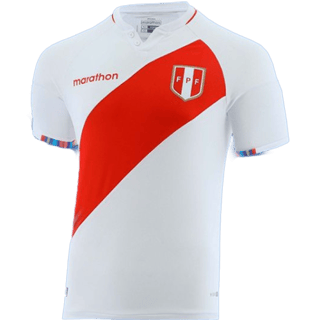
The Peru national football team represents Peru in men's international football. The national team has been organised, since 1927, by the Peruvian Football Federation (FPF). The FPF constitutes one of the 10 members of FIFA's South American Football Confederation (CONMEBOL). Peru has won the Copa América twice and qualified for FIFA World Cup finals five times (last appearing in 2018); it also participated in the 1936 Olympic football competition and has reached the semi-finals of the CONCACAF Gold Cup. The team plays most of its home matches at the Estadio Nacional in Lima, the country's capital. The team is well known for its white shirts adorned with a diagonal red stripe, which combine Peru's national colours. This basic design has been used continuously since 1936, and gives rise to the team's common Spanish nickname, la Blanquirroja ("the white-and-red"). Peruvian football fans are known for their distinctive cheer ¡Arriba Perú! ("Onward Peru!"). Peru has longstanding rivalries with Chile and Ecuador. The Peru national team enjoyed its most successful periods in the 1930s and the 1970s. In the 1930s, Peru took part in the inaugural FIFA World Cup in 1930 and enjoyed victories in the 1938 Bolivarian Games and the 1939 Copa América, with goalkeeper Juan Valdivieso and forwards Teodoro Fernández and Alejandro Villanueva playing important roles. In the 1970s, Peru qualified for three World Cups and won the Copa América in 1975, attaining worldwide recognition; the team then notably included defender Héctor Chumpitaz and the forward partnership of Hugo Sotil and Teófilo Cubillas, often regarded as Peru's greatest player. The national team's all-time top goalscorer is Paolo Guerrero, with 38 goals, and its most-capped player is Roberto Palacios, with 128 appearances. Under manager Ricardo Gareca, Peru placed third at the 2015 Copa América, reached the quarter-finals of the Copa América Centenario, participated in the group stage of the 2018 FIFA World Cup finals, and earned second at the 2019 Copa América.
Also known as: Perou, Перу, ペルー, بيرو
| # | Player | Pos | Ht / Wt | Age |
|---|---|---|---|---|
| 1 | Alejandro Duarte | G | — | 32 |
| 1 | Diego Enríquez | G | — | 24 |
| 1 | Diego Romero | G | — | 25 |
| 1 |  Pedro Gallese Pedro Gallese | G | — | 36 |
| 3 |  Carlos Zambrano Carlos Zambrano | D | — | 37 |
| 4 | Anderson Santamaría | D | — | 34 |
| 4 |  Fabio Gruber Fabio Gruber | D | — | 24 |
| 5 | Alfonso Barco | M | — | 24 |
| 6 | Jesús Castillo | M | — | 25 |
| 6 | Renzo Garcés | D | — | 30 |
| 6 |  Sergio Peña Sergio Peña | M | — | 30 |
| 8 | Erick Noriega | M | — | 24 |
| 8 | Jesús Pretell | M | — | 27 |
| 9 | Adrián Ugarriza | F | — | 29 |
| 9 | Luis Ramos | F | — | 26 |
Looking to place bets on the Peru? Bettors in Illinois have access to competitive International odds from licensed sportsbooks operating in the state. We compare moneylines, point spreads, and totals from multiple bookmakers to help you find the best value.
Peru games typically generate strong betting action, especially for division matchups and primetime matches. Our odds comparison updates frequently throughout the week, so check back before placing your wagers to ensure you're getting the best available lines in Illinois.
Videos and posts straight from the club’s official channels.
Content provided by YouTube, Facebook.