 NCAASat, Sep 19 4:00 PM EDT
Home
Duke
VS

Away
Stanford
Lines not posted yet
Sportsbooks usually open this market closer to game time. The comparison appears here the moment they do.



Get odds & game alerts
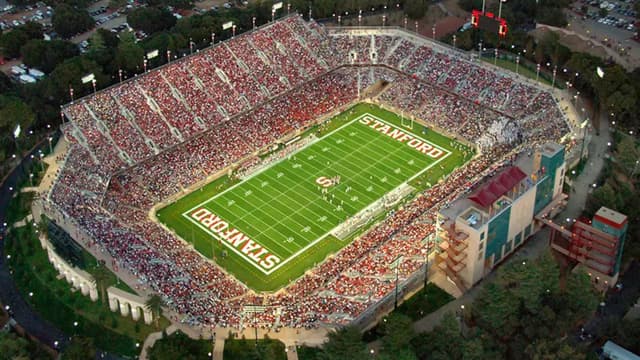
Stanford Stadium is an outdoor college football stadium on the west coast of the United States, located on the campus of Stanford University in Stanford, California. It is the home of the Stanford Cardinal and hosts the university's commencement exercises. Opened in 1921 as a football and track and field stadium, it was an earthen horseshoe with wooden bleacher seating and flooring upon a steel frame. Its original seating capacity was 60,000, which grew to 89,000 by 1927 as a nearly enclosed bowl. Immediately following the 2005 season, the stadium was demolished and rebuilt as a dual-deck concrete structure, without a track. Today, it seats 50,424. The natural grass playing field runs northwest to southeast, at an approximate elevation of sixty feet (18 m) above sea level.
Compare moneyline, spread and totals from licensed sportsbooks for every game.
NCAASat, Sep 19 4:00 PM EDTLines not posted yet
Sportsbooks usually open this market closer to game time. The comparison appears here the moment they do.
NCAASat, Sep 26 6:30 AM EDT
Lines not posted yet
Sportsbooks usually open this market closer to game time. The comparison appears here the moment they do.
NCAAFri, Oct 2 8:00 PM EDT
Lines not posted yet
Sportsbooks usually open this market closer to game time. The comparison appears here the moment they do.
NCAAFri, Oct 9 11:30 PM EDT
Lines not posted yet
Sportsbooks usually open this market closer to game time. The comparison appears here the moment they do.
1W – 1L over the last 2 games
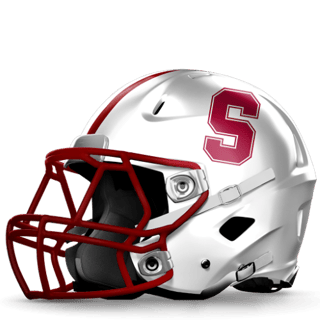
The Stanford Cardinal football program represents Leland Stanford Junior University in college football at the NCAA Division I FBS level and is a member of the Atlantic Coast Conference. The program was previously in the Pac-12 Conference. The team is known as the Cardinal, adopted prior to the 1982 season; the name represents the color – Cardinal, a deep shade of red – rather than the similarly-named bird (Cardinalis cardinalis), which is not native to the university's region. Stanford's sports teams were known as the "Cardinal" for its first two decades of athletic competition, then more commonly as the "Cardinals" until 1930. The name was changed to the "Indians" from 1930 to January 1972, and back to the "Cardinals" from 1972 through 1981. A student vote in December 1975 to change the nickname to "Robber Barons" was not approved by administrators. Stanford has fielded football teams every year since 1892 with a few exceptions. Like a number of other teams from the era concerned with violence in the sport, the school dropped football in favor of rugby from 1906 to 1917. The school also did not field a team in 1918 (due to World War I) or in 1943, 1944, and 1945 (due to World War II). The school participated in the first-ever Rose Bowl against Michigan in 1902, in which they were routed 49–0. Its annual Big Game against California is the oldest and most storied rivalry in the Pac-12 and western United States. The Cardinal also compete for the Legends Trophy against independent rival Notre Dame. The program has an all-time record of 664–478–49 for a winning percentage of .578 and has winning series records against all of its Pac-12 North rivals, except for the Washington Huskies, against whom they are tied 43–43–4. Stanford claimed national championships in 1926 and 1940. In 1926, led by legendary coach Glenn "Pop" Warner, the team was undefeated in the regular season and tied Alabama in the 1927 Rose Bowl. The 1940 team went unbeaten and untied after defeating Nebraska 21–13 in the 1941 Rose Bowl, but the team ranked No. 2 in the final AP poll released before the game was played. Pop Warner's era predated the AP poll, but Stanford has finished at least one season in the Top 10 in six different decades under seven different coaches: Claude E. Thornhill in 1934, Clark Shaughnessy in 1940, Chuck Taylor in 1951, John Ralston in 1970 and 1971, Bill Walsh in 1992, Jim Harbaugh in 2010, and David Shaw in 2011, 2012, and 2015.
Also known as: Stanford Cardinal, Cardinal, STAN
| # | Player | Pos | Ht / Wt | Age |
|---|---|---|---|---|
| 0 | Kenaj Washington | RB | — | — |
| 19 | Caleb Ellis | SAF | — | — |
| 20 | Danny McFadden | RB | — | — |
| 21 | Caleb Robinson | RB | — | — |
| 22 | Daylen Sharper | WR | — | — |
| 22 | Jason Kaul | LB | — | — |
| 23 | Jacob Lowe | FB | — | — |
| 24 | Jay Symonds | FB | — | — |
| 25 | Brandon Jones | CB | — | — |
| 26 | Jason Thompson | WR | — | — |
| 27 | Devin Mignery | QB | — | — |
| 32 | Donovan Jones | TE | — | — |
| 33 | Lasiah Jackson | DB | — | — |
| 41 | Lucas Shanafelt | OLB | — | — |
| 42 | Bailey Parsons | LS | — | — |
Looking to place bets on the Stanford? Bettors in Ohio have access to competitive NCAAF odds from licensed sportsbooks operating in the state. We compare moneylines, point spreads, and totals from multiple bookmakers to help you find the best value.
Stanford games typically generate strong betting action, especially for division matchups and primetime games. Our odds comparison updates frequently throughout the week, so check back before placing your wagers to ensure you're getting the best available lines in Ohio.
Videos and posts straight from the club’s official channels.
Content provided by YouTube.
Latest videos from Stanford


